May 27,2026
Energy Storage Connector Maintenance and Inspection Best Practices

You walk into the battery storage room for a routine check. Nothing looks obviously wrong—no smoke, no smell, no visible damage. But somewhere inside that rack of battery modules, a connector is quietly heating up. By the time you can see or smell the problem, the damage may already be done.
How do you catch these hidden hot spots before they escalate? And how often should you be looking?
This guide provides a practical inspection framework for energy storage connectors—covering what to check, how often, and when to adjust your schedule based on your system's operating conditions.
A connector hot spot is not just a warm component—it is a warning sign. When an energy storage connector degrades, contact resistance multiplies rapidly. This localized heat buildup damages surrounding insulation, and a connector failure can trigger a cascade of safety incidents: thermal runaway, electrical arcing, and catastrophic system fires.
The physics are straightforward. Loose or corroded connections create high-resistance points. That resistance generates heat through Joule heating—the same principle that makes a wire glow in a toaster. In a battery energy storage system (BESS), where connectors routinely carry hundreds of amps, even a small increase in contact resistance can produce significant localized heating.
What this means for you: A hot spot is never “just a hot spot.” It is the visible symptom of an underlying problem—loose torque, oxidation, thermal cycling damage, or mechanical wear. Left unaddressed, that warm connector can melt insulation, degrade adjacent cells, and eventually force an unplanned system shutdown that costs far more than a scheduled inspection.
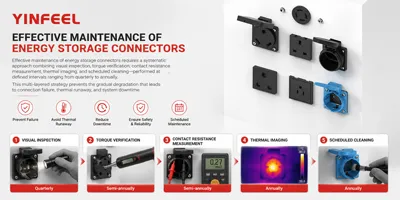
Not every connector needs the same level of attention. A tiered inspection schedule—ranging from daily visual checks to annual comprehensive assessments—ensures you catch problems early without over-inspecting stable systems.
| Inspection Level | Frequency | What to Check | Why It Matters |
|---|---|---|---|
| Daily / Shift Visual | Each operating shift | Discoloration, melting, cracks, unusual odor | Catches obvious failures before they escalate |
| Monthly Thermal Scan | Monthly (during peak load) | Infrared imaging of all accessible connectors | Detects developing hot spots before visible damage appears |
| Quarterly Contact Review | Every 3 months | All contact points—visual + thermal + torque spot-check | Prevents resistance buildup from going unnoticed |
| Bi-Annual Deep Maintenance | Every 6 months | Deep cleaning, dielectric grease renewal, latch inspection | Addresses oxidation and mechanical fatigue |
| Annual Comprehensive | Every 12 months | Full continuity test, insulation resistance measurement, detailed thermal imaging | Provides baseline data and catches slow-developing issues |
Daily visual checks take minutes but pay dividends. Look for signs of discoloration or melting on the housing. Check for cracks, deformation, corrosion, or wear on the connector body and pins. A quick walk-through during shift change can catch a problem that would otherwise fester for weeks.
Monthly thermal scans are where hot spots get caught early. Using an infrared camera during peak load conditions reveals temperature anomalies that are invisible to the naked eye. A temperature deviation above 10°C between similar connectors or between a connector and its cable indicates high resistance—often from a loose contact.
Quarterly contact reviews go deeper. Professionals recommend a quarterly review of all contact points to prevent resistance buildup. This is the level where you clean contacts, verify torque on critical connections, and document thermal trends.
Bi-annual deep maintenance addresses the slow creep of oxidation and mechanical wear. Every six months, perform ultrasonic cleaning to remove surface oxidation. Check locking latches for mechanical fatigue. Inspect cable insulation for thermal degradation. In dusty environments, spring mechanisms may need checking monthly.
Annual comprehensive inspections provide the system-level view. Full continuity testing and insulation resistance measurement confirm that the entire connector network is performing within specification. This is also the time to compare thermal imaging data year-over-year—trends matter more than single measurements.
The frequencies above are guidelines, not rigid rules. Your system's operating environment and criticality should drive the actual schedule.
High-load environments: Systems that regularly operate near rated capacity generate more heat and stress connectors more aggressively. Monthly thermal scans may become weekly.
Harsh environmental conditions: Dusty environments accelerate mechanical wear on latches and springs. Coastal areas with salt spray accelerate corrosion and may require quarterly corrosion checks.
Critical systems: For utility-scale BESS serving grid stabilization or critical infrastructure, more frequent inspections are justified. For critical systems or harsh environments, comprehensive inspections may be needed semi-annually rather than annually.
History of problems: If a system has experienced connector issues before, increase the inspection frequency. NFPA 70B recommends quarterly or semi-annual inspections where warranted by loss experience or changes in environmental conditions.
Recent modifications: Any electrical system modification or repair should trigger an immediate inspection.
Stable, low-load residential systems: Small residential storage systems with consistent, moderate loads may follow the minimum annual schedule.
New installations with clean history: After the first year of successful operation with no thermal anomalies, some operators extend intervals—but never eliminate inspections entirely.
A systematic inspection checklist ensures you don't miss anything. Here is what to check at each level:
Housing condition: Cracks, discoloration, melting, or brittleness
Contact surfaces: Oxidation, corrosion, pitting
Locking mechanisms: Proper engagement, mechanical fatigue, spring tension
Cable insulation: Thermal degradation, cracking, exposure
Sealing rings: Cracks or wear that could compromise the IP rating
Temperature comparison: Compare connector temperatures to adjacent cables and to similar connectors in the same system
Delta-T threshold: A temperature deviation above 10°C between a connector and its cable—or between similar connectors—indicates high resistance
Peak load timing: Thermal scans are most revealing during peak load conditions
Contact resistance: Normal range is below 0.5 mΩ; values above 1.0 mΩ require action
Insulation resistance: Should exceed 500 MΩ; below 100 MΩ is critical
Continuity testing: Confirm uninterrupted current paths
Torque verification: All threaded connections should meet manufacturer specifications
Cleaning: Remove dust and oxidation using approved non-conductive cleaners
Dielectric grease: Re-apply if specified by the manufacturer
Secondary locking clips: Verify presence and function
For project developers and system integrators managing large-scale installations, this system operates at high load, often in outdoor environments, and serves critical grid functions. Recommended schedule: Daily visual checks by operations staff; weekly thermal scans during peak periods; quarterly comprehensive visual + thermal + torque inspections; bi-annual deep cleaning and latch inspection; annual full electrical verification. For coastal or dusty sites, increase corrosion and latch checks to monthly.
This system sees moderate loads with occasional high-demand events. Recommended schedule: Weekly visual checks; monthly thermal scans; quarterly contact reviews; bi-annual deep maintenance; annual comprehensive inspection. Adjust upward if the system is frequently cycled or if the environment is harsh.
This system operates at lower loads and in more controlled environments. Recommended schedule: Monthly visual checks; quarterly thermal scans (or when performing other maintenance); annual comprehensive inspection including thermal imaging and contact resistance measurement.
Establishing a regular inspection schedule is the foundation of connector reliability. But the best inspection program cannot compensate for connectors that are poorly specified for their application. The frequency of inspection should inform—and be informed by—the quality and suitability of the connectors you choose.
Ask yourself these questions as you plan your inspection program:
What is my system's operating profile? High-load, high-cycle systems need more frequent inspections and connectors rated for those conditions.
What is the environment? Dust, salt spray, temperature extremes—all demand both more frequent inspections and connectors designed for those conditions.
What is the criticality? Grid-serving systems justify more frequent inspections than residential backup.
What is my inspection capability? Do you have access to thermal imaging equipment? Trained personnel? The answers affect what you can inspect and how often.
Once you have clarified these factors, selecting connectors that match your system's demands—and planning an inspection schedule that matches the connectors' capabilities—becomes the next logical step. You can review connector series designed for high-current energy storage applications, or explore the hardware accessories and socket solutions that support reliable power distribution.
For a deeper understanding of connector performance over time, you may also find our guide on How to Evaluate Connector Contact Resistance and Temperature Rise helpful—a topic that directly informs what you should be measuring during your inspections.
Are Modular Energy Storage Connectors Worth the Investment? | YINFEEL
Energy Storage Connectors vs EV Charging Connectors: 5 Differences | YINFEEL
Understanding UL 4128: A Guide to Energy Storage Connector Certification
IP Ratings Explained: What IP67, IP68, and IP6K9K Mean for Your Connector Choice
Connector Temperature Rise: Why It Matters and How to Measure It
This article is part of YINFEEL's technical content library. No direct sales or pricing information is included. All technical discussions aim to help you make informed purchasing decisions.