May 23,2026
Energy Storage Connector Selection Guide: How to Choose the Right Connector for Your ESS

When designing or maintaining a battery energy storage system (BESS), one of the most overlooked yet mission-critical decisions is choosing the right connector for high-current paths. A loose or undersized connection can lead to voltage drop, overheating, or even thermal runaway. On the other hand, an over-engineered solution adds unnecessary cost and installation complexity.
So how do you pick the optimal energy storage connector for your high-current application without getting lost in marketing claims? Let’s break it down into six practical steps.
Many engineers focus only on the maximum current rating printed on the datasheet. But in real-world BESS operation, the continuous current and peak surge matter just as much.
Continuous load: Typically 0.5 °C to 1 °C for lithium battery banks. A 100Ah battery at 1C means 100A continuous.
Peak load: Some systems experience 2C–3C for a few seconds. Your connector must handle that without degrading.
Ask yourself: Does the connector specify both continuous and short-term ratings? Are they based on UL 4128 or IEC 61984? For high-current scenarios above 200A, copper-based connection interfaces are almost always preferred over aluminum or brass alternatives due to better conductivity and creep resistance.
Learn more about matching connector ratings to real BESS loads
The contact surface is where most resistive losses occur. Base material and plating directly affect contact resistance, corrosion resistance, and mating cycle life.
| Material/Plating | Conductivity | Corrosion Resistance | Cost | Best For |
|---|---|---|---|---|
| Pure copper | Excellent | Poor | Medium | Dry indoor applications |
| Copper + silver plating | Excellent | Good | High | High-frequency switching |
| Copper + nickel plating | Good | Very good | Medium | Humid or salt-spray environments |
| Copper + tin plating | Good | Good | Low-medium | General BESS, cost-effective |
| Brass | Moderate | Fair | Low | Not recommended for >100A |
For high-current energy storage connectors, copper alloy with nickel or silver plating offers the best balance of low contact resistance and long-term reliability. Avoid bare copper unless the connector is hermetically sealed – oxidation will increase resistance over time.
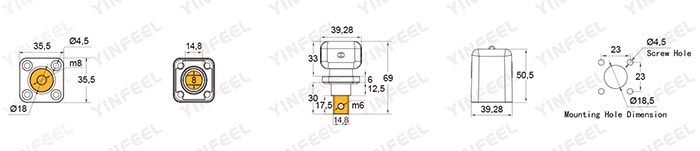
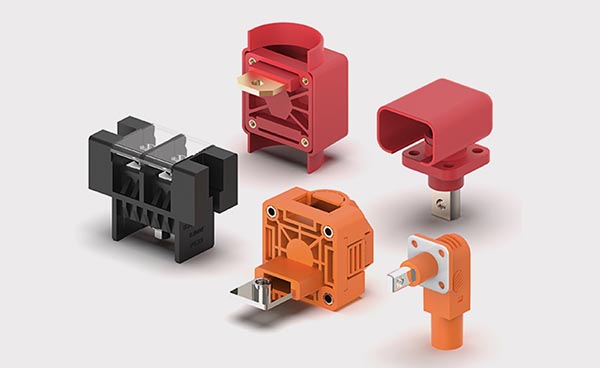
A note on a specific design: Some applications require a lithium battery post with a high-current copper terminal that directly clamps onto the battery stud. While effective in certain topologies, such terminals must be carefully torqued and inspected regularly.
High-current connectors are often mated and unmated during system assembly or maintenance. Poor mechanical design leads to:
Partial engagement → high resistance → hot spots
Accidental reverse polarity → short circuit
Vibration loosening → intermittent connection
Look for:
Secondary locking
Keyed / polarized housings to prevent mis-mating
Low insertion force (LIF) design for multi-pole connectors – especially important when you have dozens of connections in a battery rack
For busbar-style connections, ensure the contact area is flat, and the bolt torque specification is clearly stated. Many field failures trace back to under-torqued or over-torqued copper terminals.
Any connector used in a commercial or utility-scale energy storage system should meet at least one of these standards:
UL 4128 – covers connectors within BESS
UL 1977
IEC 61984
IEC 62852
Ask your supplier for test reports. A genuine UL or TÜV mark is far more trustworthy than a self-declared “CE” or “RoHS” claim.
[Image: Close-up of a certified energy storage connector showing UL logo and rating markings – example only]
For high-current DC applications, also verify the rated breaking capacity (if the connector is designed to be disconnected under load). Most rectangular or circular connectors are not load-break rated unless specified. For battery disconnects, use a dedicated DC breaker or switch – not a standard connector.
See which compliance documents we provide for each connector series
Even the best connector fails if installed incorrectly. Based on field feedback from BESS integrators, here are the top three mistakes:
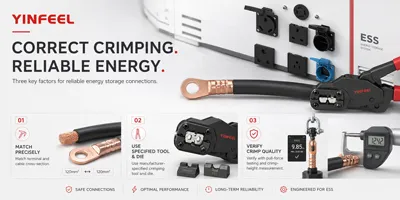
Using the wrong crimping tool – A generic tool can create cold welds or loose strands. Use the manufacturer’s specified crimp die and verify with a pull test.
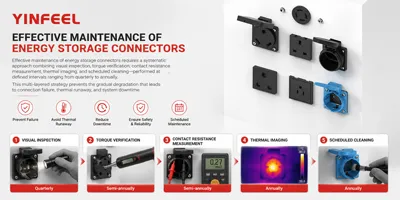
Ignoring torque requirements – Over-torquing strips threads; under-torquing increases contact resistance. Use a torque wrench.
Mixing dissimilar metals – Copper to aluminum without a bi-metallic washer causes galvanic corrosion. Always use plating or washers that match.
Also, schedule thermal imaging during commissioning and after the first month of operation. A connector that runs 15°C above ambient is a warning sign. At 30°C above, replace it immediately.
To select the right energy storage connector for your high-current project, answer these four questions:
| Question | Option A (Low-risk) | Option B (Budget) |
|---|---|---|
| Continuous current | ≥150A → Copper with Ni/Ag plating | <100A → Tin-plated copper |
| Environment | Outdoor / coastal → IP67 + nickel | Indoor dry → IP20 + tin |
| Mating cycles | >100 cycles → Silver or gold plating | <50 cycles → Tin plating |
| Certification needed | UL / TÜV | UL recognized component |
If most of your answers fall into the low-risk column, invest in a premium-grade copper alloy connector with a proven track record. If the budget is tight but safety remains critical, focus on proper torque and regular inspection rather than the cheapest part.
Selecting connectors is only half the story. Consistency in manufacturing, traceability, and technical support makes the difference between a one-time project and a long-lasting BESS.
If you’re looking for a supplier that offers test-verified copper connectors for high-current applications (from 50A to 400A), with full documentation and responsive engineering support, you can explore the options available at:
The product pages include detailed datasheets, 3D drawings, and material certificates – so you can verify every specification before ordering.
Disclaimer: This article provides general guidance. Always consult a licensed electrical engineer for your specific BESS design and comply with local electrical codes (NEC, IEC, etc.).